
OUR COMMITMENT
More conscious choices with environmental product declarations. We want to raise awareness of the environmental impacts of Wasa products by communicating through the Environmental Product Declarations.
CRUUUUUUNCHWHAT IS A CARBON FOOTPRINT?
A product’s carbon footprint is the total amount of greenhouse gases released into the atmosphere throughout its life cycle, showing the product’s contribution to climate change from field, through shelf, and to end-of-life. A carbon footprint is expressed in units of mass of carbon dioxide equivalents (CO2e), or in other words as if only CO2 was emitted into the atmosphere, thanks to the conversion framework set by the Intergovernmental Panel for Climate Change (IPCC).
Intergovernmental Panel for Climate Change (IPCC)
The Intergovernmental Panel on Climate Change (IPCC) is an international body established by the United Nations (UN) and the World Meteorological Organization (WMO) in 1988 to evaluate scientific information related to climate change. For further information https://www.ipcc.ch/.
At Wasa, we take a full look at our CO2e emissions involved with making crispbread, from the cultivation of raw materials to packaging our products to delivering them and anywhere in between, including the end-of-life of packaging.
The Carbon Footprint and other environmental impact indicators of our products are communicated through Environmental Product Declarations (EPDs), described and explained further below.
To develop EPDs, we follow the rules set by the International EPD System. According to these rules, the Carbon Footprint is calculated using the approach and emission factors identified in the Sixth Assessment Report of the Intergovernmental Panel on Climate Change (IPCC) released in 2021, (more information at the following link) and including all the greenhouse gases, such as:
- carbon dioxide (CO2),
- methane (CH4),
- nitrous oxide (N2O),
- hydrofluorocarbons (HFCs),
- perfluorocarbons (PFCs),
- sulphur hexafluoride (SF6),
- nitrogen trifluoride (NF3)
together with other GHG gases presented in the IPCC report.
Always remember that when comparing CO2e footprints, it’s important to check which method was used to measure the emissions and which stages of the product category life cycle are included.
HOW ARE CARBON FOOTPRINTS EVALUATED AND COMMUNICATED?
LCA methodology
Life Cycle Assessment (LCA) is a method used to evaluate the environmental impacts (using key performance indicators – KPIs) of a product or service throughout its entire life cycle, from the raw materials used to make it, through its use, and finally to its disposal or recycling.
The Life Cycle Assessment methodology has been regulated by the ISO 14040:2021 and ISO14044:2021. The LCA methodology establishes what must be done to carry out and validate an LCA study in a complete and rigorous way from a scientific point of view.
Product Category Rules
Product Category Rules (PCR) are rules that guide how the environmental impact of a specific group of products should be assessed (e.g., bakery products). They arise from the need to have calculation rules that make LCA results for the same product category comparable.
In an LCA study it is possible to analyse not only carbon footprint, but many other different environmental impact indicators.
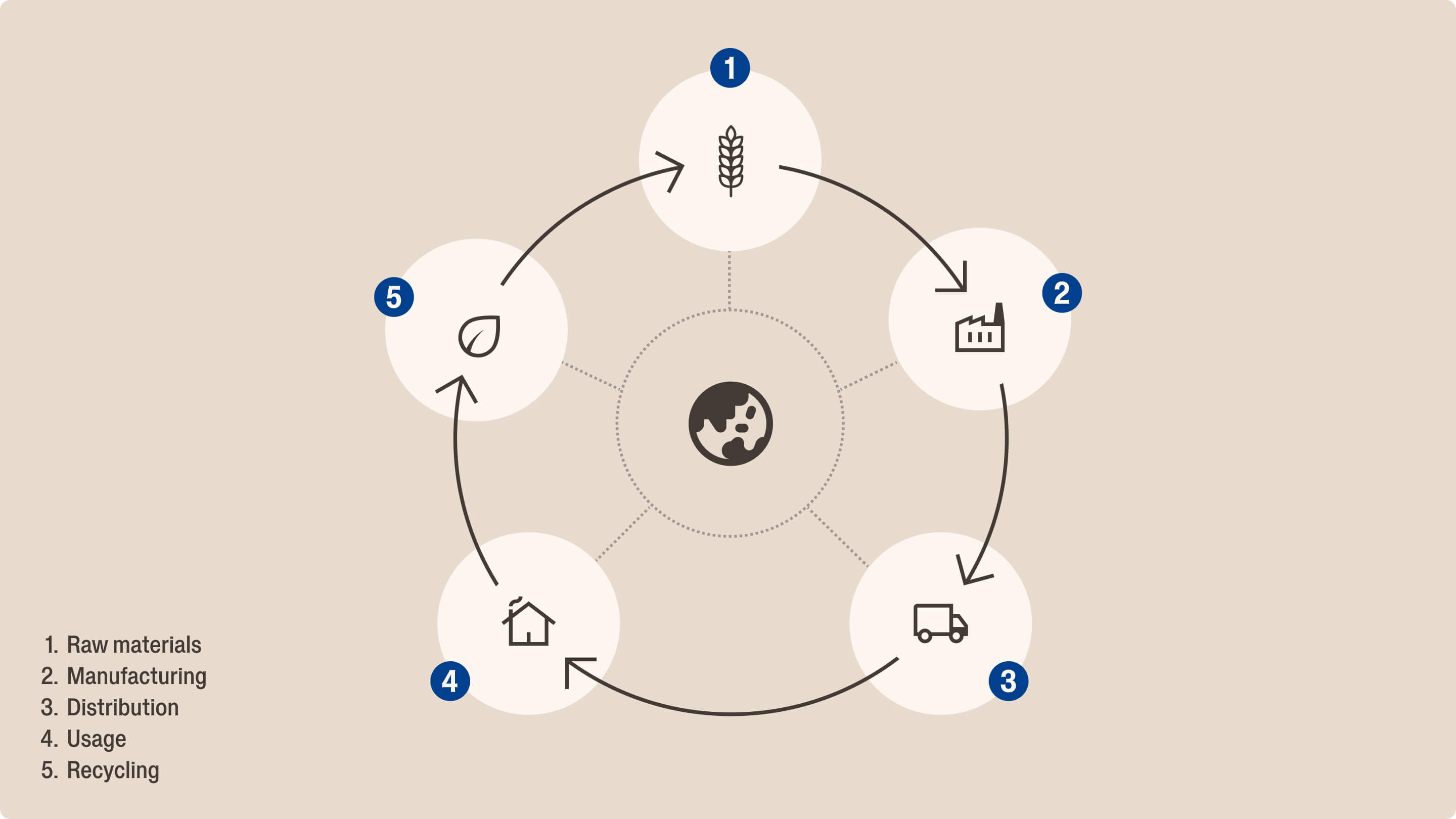
PCR for bakery products
For Wasa products, the PCR for bakery products is the PCR 2012:06, CPC 234, Bakery Product (2024 last PCR update) of the International EPD System is used available at https://www.environdec.com/pcr-library/
EPD
An EPD is a report that shares the results of an LCA study, showing the environmental impact of a product.
WHAT IS AN EPD?
The Environmental Product Declaration (EPD) presents the environmental profile of a product.
It is a registered document that communicates transparent and comparable information about the life cycle assessment results of products in a credible way and is either independently verified or based on an independently verified EPD process system.
Having an EPD for a product does not imply that the declared product is environmentally superior to alternatives — it is simply a transparent declaration of the life-cycle environmental impact.
HOW TO READ A WASA EPD?
Reading an Environmental Product Declaration (EPD) involves understanding the environmental impact of a product across its lifecycle.
The EPD document is divided into different sections:
1. PRODUCT INFORMATION
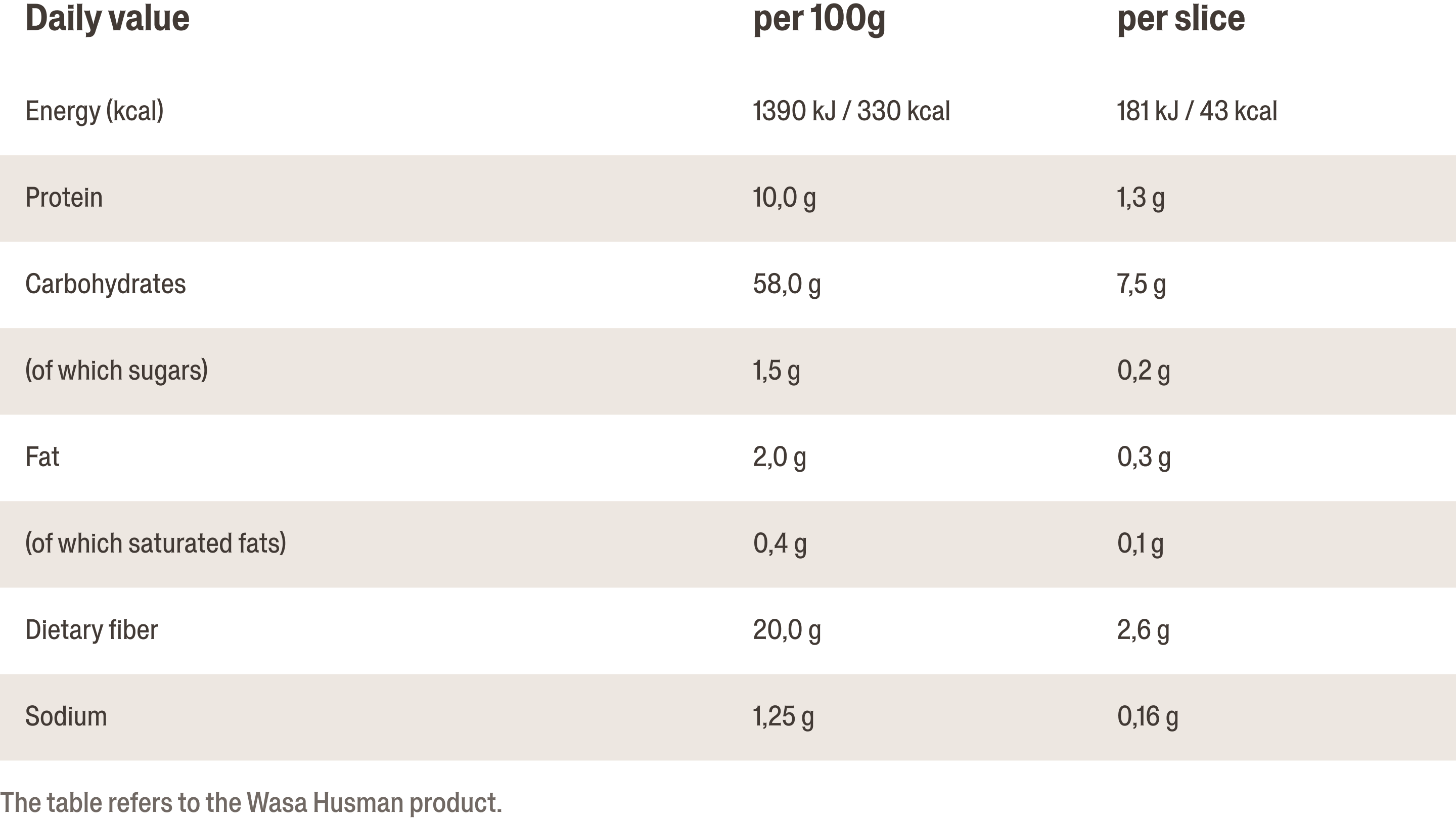
Each EPD opens with the identification of the product and its main characteristics where the reader immediately comes across its ingredients and the nutritional values.
2. SCOPE OF THE EPD
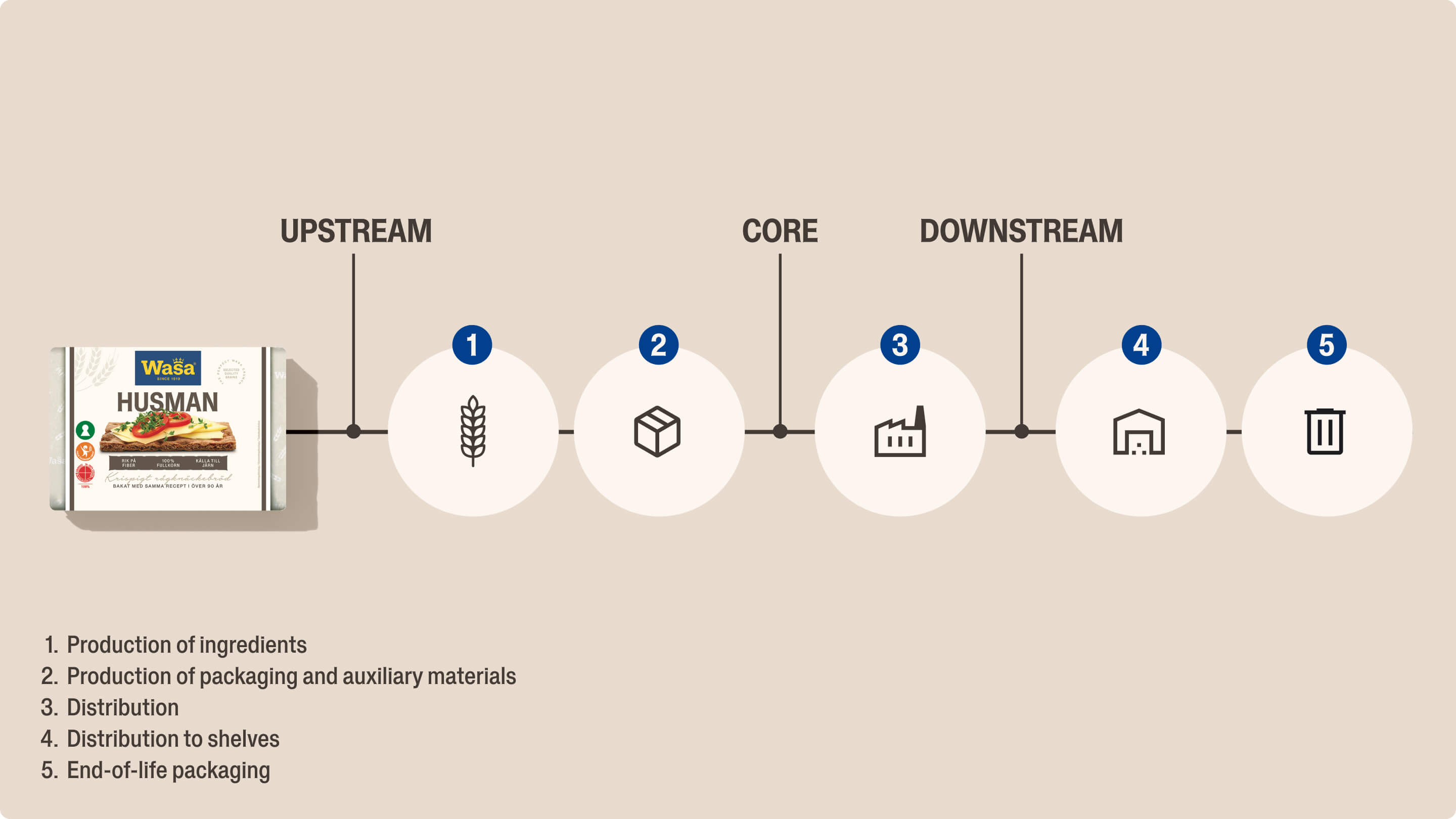
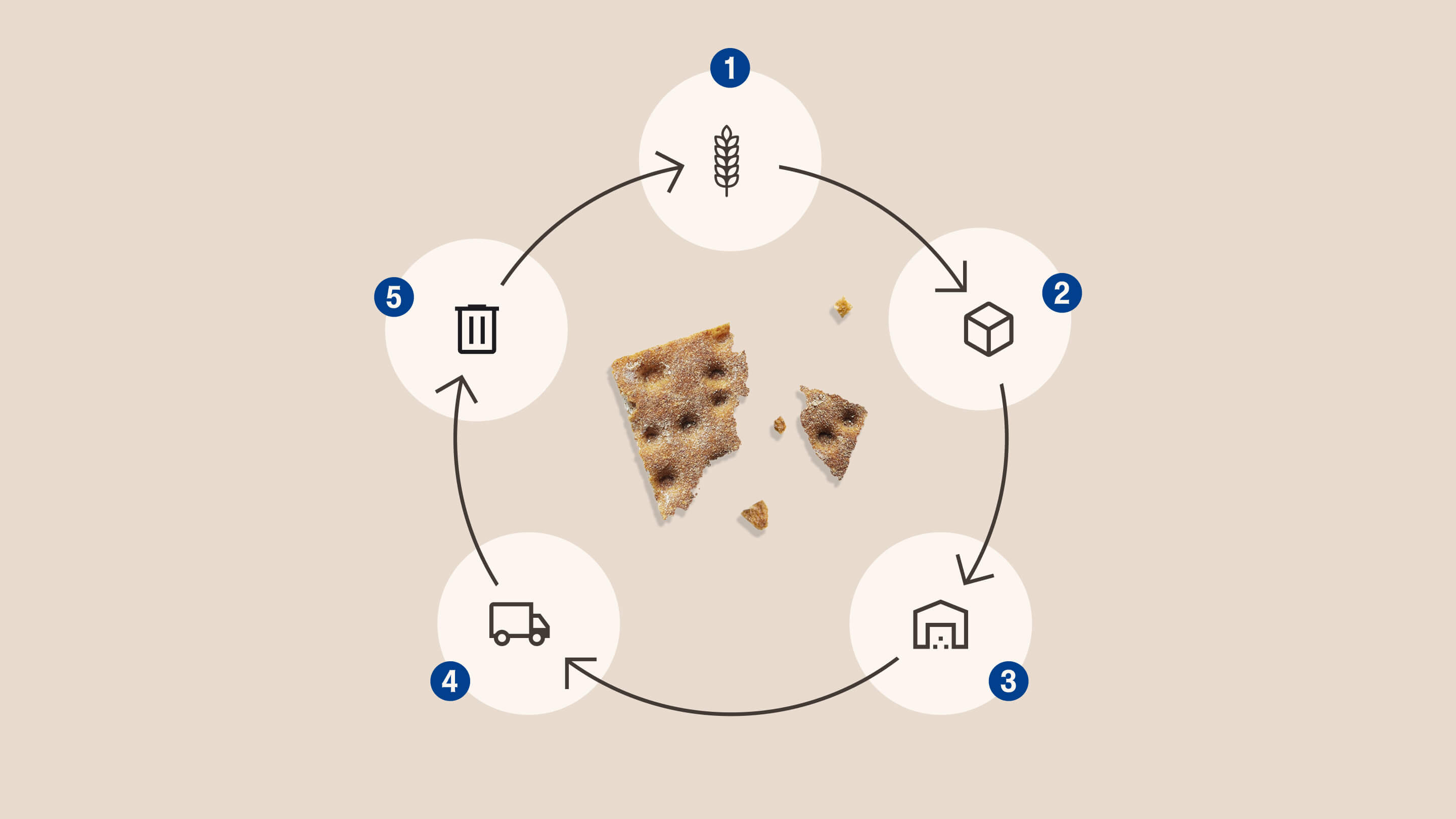
Each EPD contains a detailed description of the supply chain considered and the explanation of the phases:
- Production of ingredients
- Packaging and auxiliary materials production
- Wasa production
- Distribution up to shelf including analyzation of the impact related to end of life of packaging for transport (secondary and tertiary packaging).
- Primary packaging end of life.
Secondary and tertiary packaging
Secondary and tertiary packaging is used to group primary packages together, making the product easier to handle, store, and transport.
Primary packaging
Primary packaging is the material that comes into direct contact with the food product. It is the first layer of packaging that protects the food and preserves its quality. Primary packaging is also referred to as sales packaging because it is designed as the single unit that is purchased and consumed by the end user.
3. ASSUMPTIONS AND DATA FOR THE CALCULATION OF IMPACTS
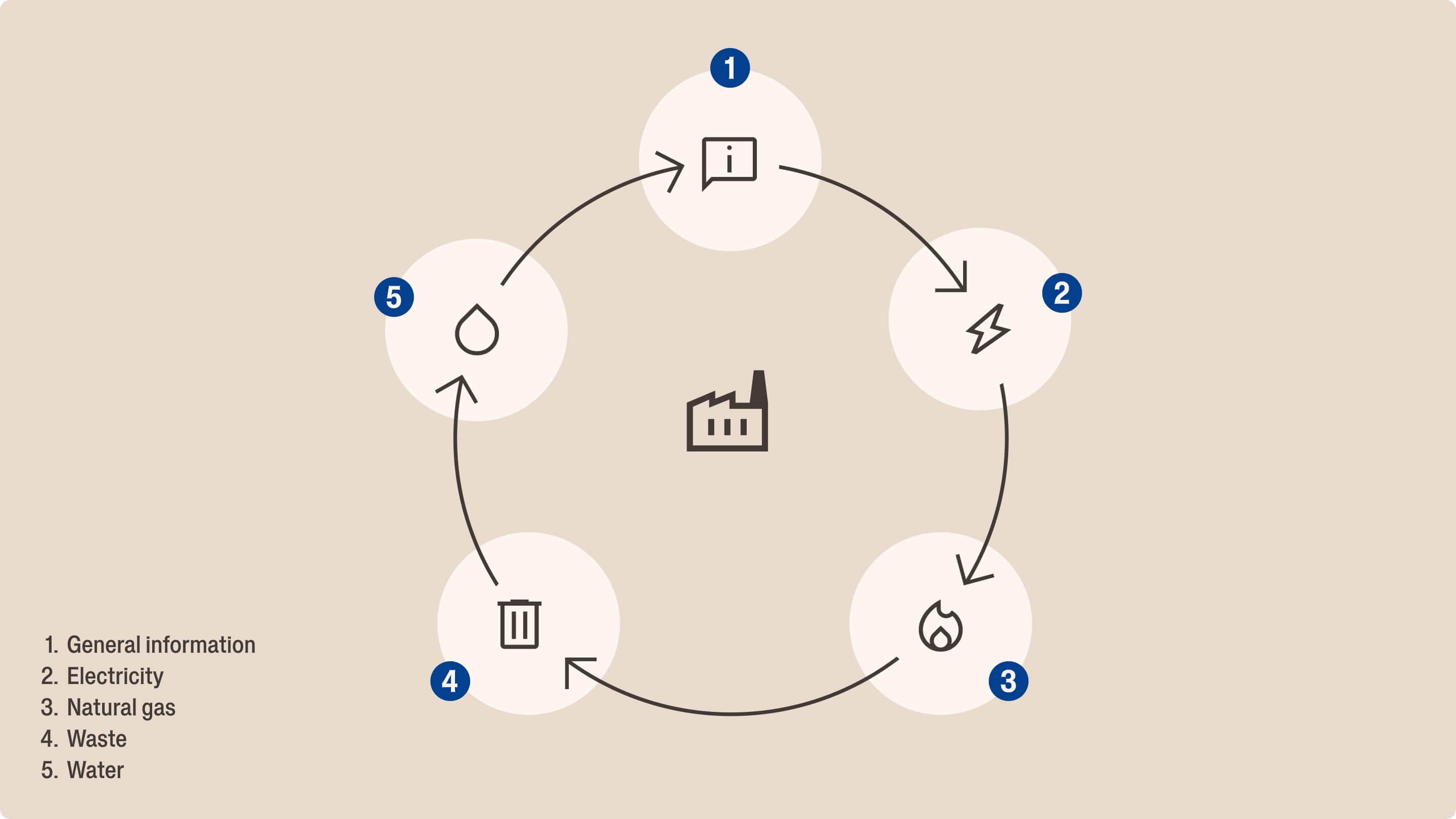
The assumptions and data used determine the quality of the results obtained. Wasa EPDs dedicates several pages to describing the assumptions and type of data used in the study.
4. ENVIRONMENTAL IMPACT RESULTS
In the case of agri-food supply chains, the main environmental aspects are those related to the generation of greenhouse gases and the use of water. To simplify the reading of the environmental indicators of each phase, Wasa EPD associates the environmental impacts in a summarizing and informative way through the main indicators in agri-food production: Carbon Footprint and Water Scarcitya.
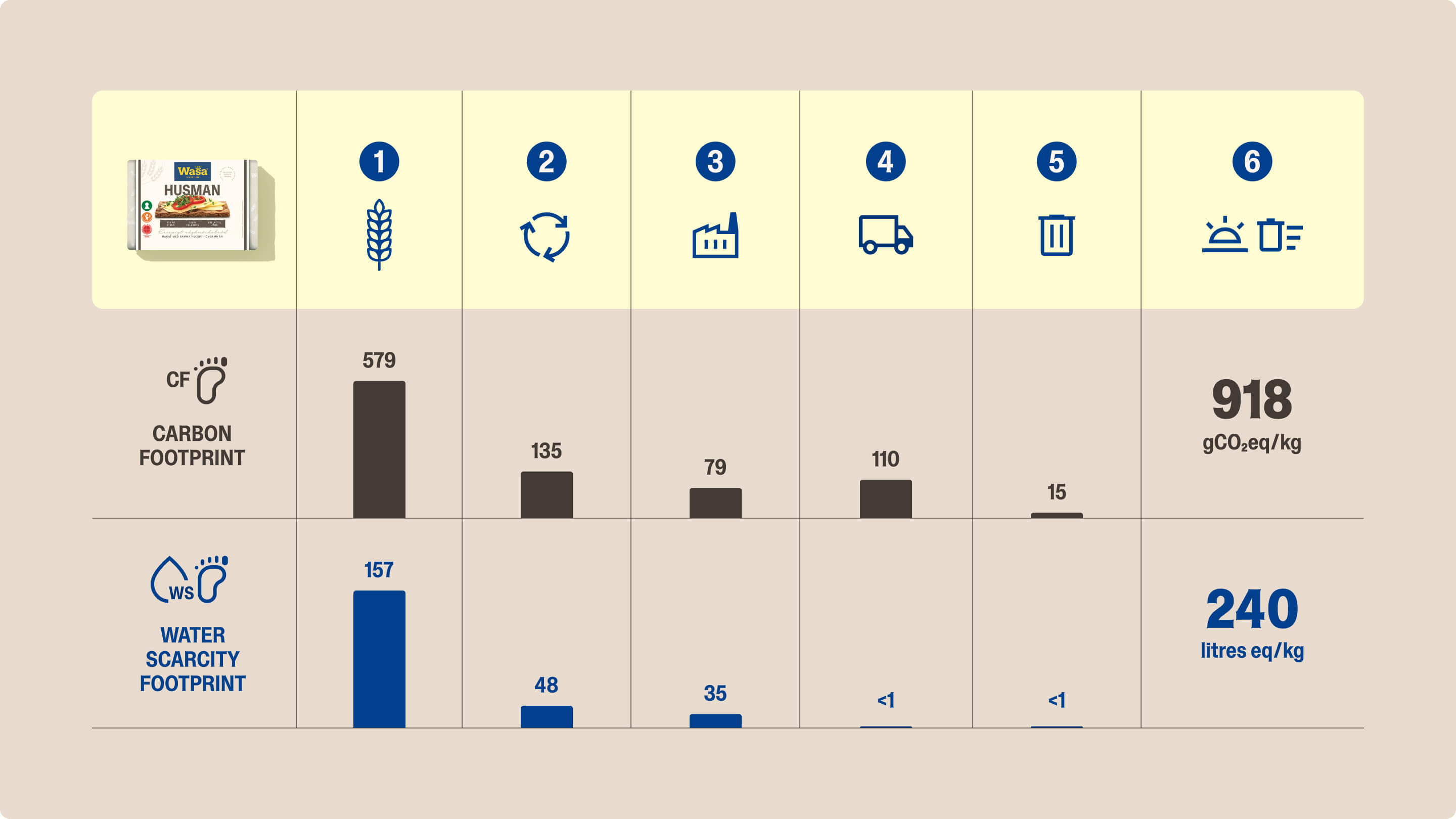
- Ingredients production
- Packaging and auxiliary production
- Wasa production
- Primary packaging end of life
- From filled to packaging end of life
Agri-food supply chain
An agri-food supply chain is the whole system that gets food from farms to your plate, involving farming, processing, transportation, retail and consumption.
1. CARBON FOOTPRINT
The Carbon Footprint equals the sum of all greenhouse gas emissions, throughout the product life-cycle, multiplied by their Global Warming Potential (GWP), indicating its impact on climate.
GWP: Global Warning Potential
Global Warming Potential (GWP) indicator is used to measure the impact of a product or process on global warming. It quantifies the potential of different gases to trap heat in the atmosphere compared to carbon dioxide (CO2e). It focuses on how much a particular gas (like methane, nitrous oxide, or CO2e) contributes to climate change over a specific time period (usually 100 years).
2. WATER SCARCITY FOOTPRINT
Water scarcity footprint refers to the impact that our actions have on the availability of fresh water. It evaluates the impact of water usage in terms of water scarcity, considering the regional availability of water and how much water is used, wasted, or polluted in the production of goods and services that we use every day.
Please note that Water Scarcity Footprint (WSP) is used to refer to the indicator Water Deprivation Potential, which is one of the mandatory indicators of environmental impact required by the International EPD System.
Water Deprivation Potential indicator
Water Deprivation Potential indicator assesses the potential environmental impact related to water scarcity. It measures the potential for water deprivation in an area due to the consumption or pollution of water resources during a product's life cycle. This indicator helps identify whether a product or process could be contributing to water shortages in areas where water resources are already limited.
Although these do not represent the totality of the impacts measured in a LCA, when combined with each other they allow us to consider the most significant environmental aspects.
THE EPD PROCESS SYSTEM
Since a high number of WASA EPDs are developed, the only way to manage them in an easy, simple and reliable manner is to use a Certified EPD Process System.
The aim of the EPD Process System is to prepare, verify and publish EPDs for Wasa’s products related to the dedicated Product Category Rules in a simpler and more functional way.
The Certified EPD Process System was developed by Barilla (that owns the Wasa Brand) in 2010. It was the first food company to obtain a third-party certification on a system measuring the environmental impact of its products, in 2011. The certification is reviewed annually and either confirmed or renewed.
How an EPD process system works?
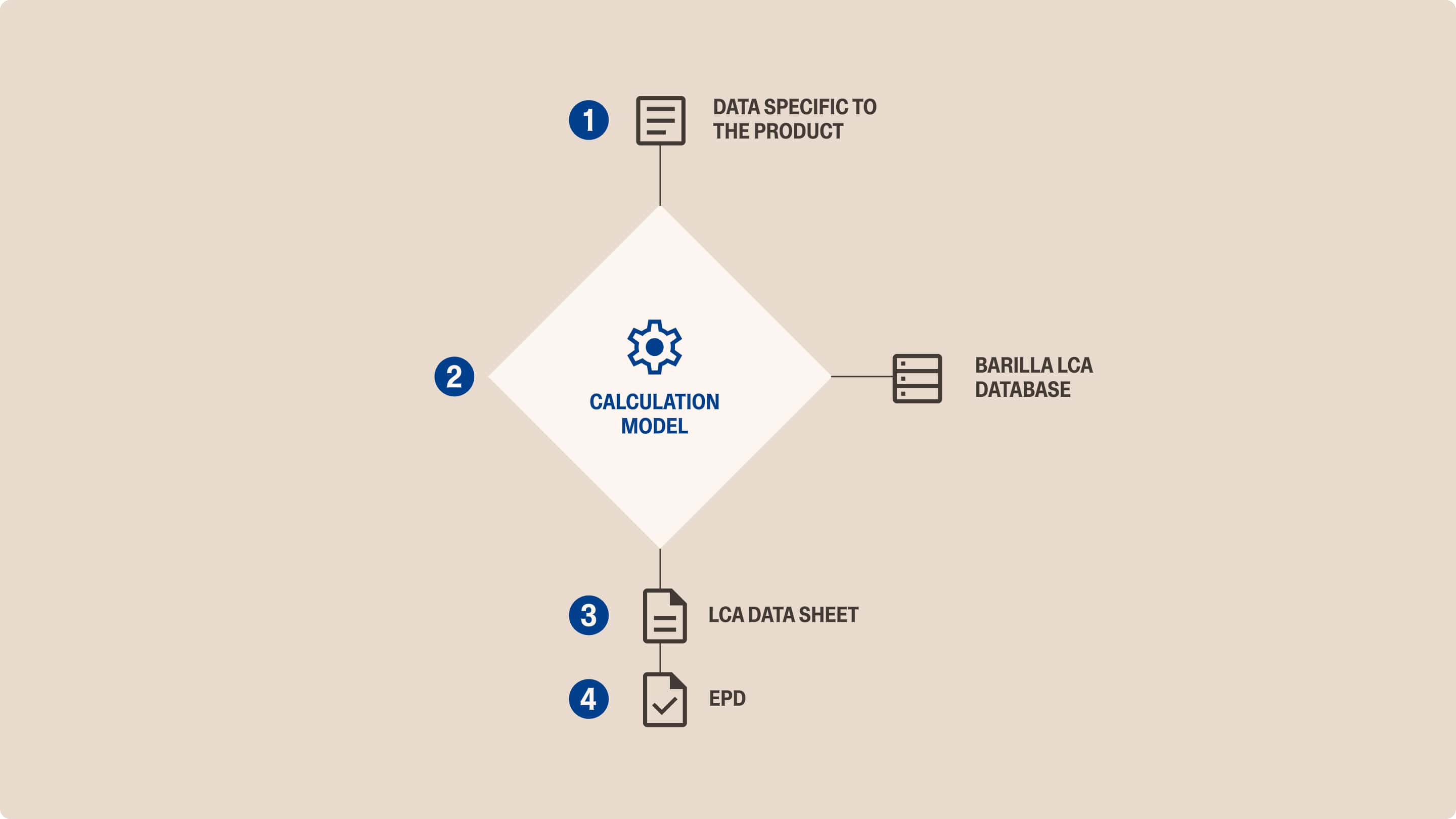
- Collection and management of data
- Data processing
- Processing of results (internal documentation production)
- EPD documentation (published on Environdec)
The Barilla EPD Process System works like a “funnel process”: the execution of LCA studies and the preparation of EPDs is based on the interaction of three elements:
1. Data specific to the product
2. Barilla LCA Database
3. Calculation models
Product-specific data includes information on:
1. The recipe: type of ingredients, quality used
2. The packaging bill material (primary and secondary packaging materials and packing materials for transport: type of materials, quantity of materials)
3. Production plant and specific consumption of the production line (general information, electricity, methane gas, water, waste)
4. The modes of transport, distances travelled, quantity transported
5. The end-of-life of primary packaging: destination of primary packaging material
The Barilla database contains data modules. Each data module is a model of a real process that contains quantitative information on the environmental aspects of the process it represents.
The main data module categories concern:
- The raw materials (ingredients) used in the recipes of the products
- The packaging materials used for the storage and transport of the product
- The production of electrical and thermal energy;
- Barilla production plants;
- The means of transport used for the distribution of products
For the realization of the modules, the data usable are PRIMARY (information from specific data collections of Barilla's processes or its suppliers) and SECONDARY DATA (retrieved from commercial databases).
The calculation model is the backbone of data processing and results for a given product category.
HOW DOES CALCULATION WORK?
Impacts of the recipe per 1 kg of final product
Impacts of packaging associated per 1 kg of product
Impacts of energy and water consumation and waste production related to 1 kg of product
Impacts related to trasport of 1 kg of product
Equivalent to
Total impacts per 1kg of product along its entire life cycle
HOW DOES CERTIFICATION WORK?
Barilla carries out a database updating at least once per year in line with the availability of information relating to company production processes.
With EPD process certification, Barilla handles the verification of EPD data by itself and issues EPDs without a third-party verifier being involved in each case.
EDP results let consumers compare similar products that follow the same rules for the value calculated.
WHAT IS THE INTERNATIONAL EPD SYSTEM?
Environmental Product Declarations (EPDs) are developed in application of the ISO 14025 Standard, which establishes that each system must have a manager (the so-called "Program Operator") who defines the operating regulations and keeps the register of validated environmental product declarations updated.
The Program Operator chosen for Wasa EPDs is the International EPD System, which today represents the only system that serves the entire international market and all product categories.
WASA EPD LIBRARY
Delikatess EPD
Take a look at the EPDs published for the following Wasa products.
Havre EPD
Take a look at the EPDs published for the following Wasa products.
Wasa 100 EPD
Take a look at the EPDs published for the following Wasa products.
Frukost EPD
Take a look at the EPDs published for the following Wasa products.
Sesame & Sea Salt EPD
Take a look at the EPDs published for the following Wasa products.
Sandwich Cheese & Chives EPD
Take a look at the EPDs published for the following Wasa products.
Surderg Flerkorn EPD
Take a look at the EPDs published for the following Wasa products.
Husman EPD
Take a look at the EPDs published for the following Wasa products.
Delicate Crisp Rosemary & Sea Salt EPD
Take a look at the EPDs published for the following Wasa products.